AI & Robotics
What is Agentic AI? 5 Business Use Cases Driving Operational Efficiency in Hong Kong
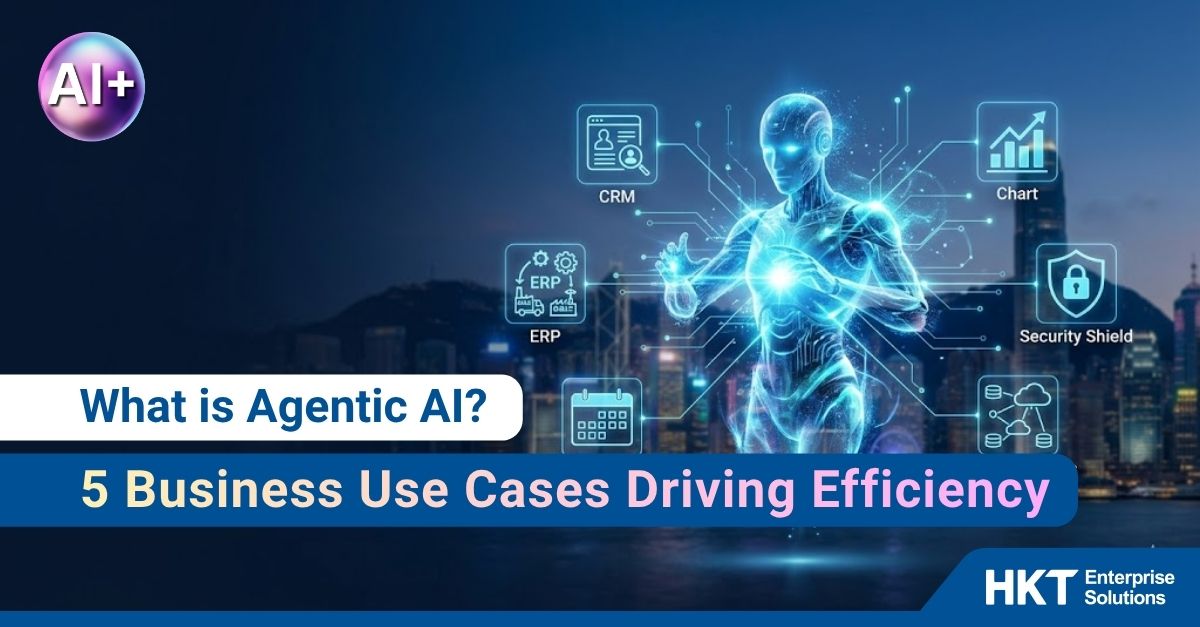
Something has shifted in enterprise AI over the past year. The conversation has moved from chatbots that answer questions to systems that actually get work done. Gartner's 2026 CIO survey found that 17% of organisations have deployed AI agents so far, and another 60% plan to follow within the next year or two. That is a fast curve by any measure.
This article covers three things: what Agentic AI is, where it is already working, and 5 use cases worth a closer look for Hong Kong enterprises.
1. What is Agentic AI?
The simplest way to understand it: Traditional AI answers your question. Agentic AI completes your task.
Put another way:
- Generative AI (e.g. ChatGPT) is like a consultant — it gives you advice, but you still need to do the work.
- Agentic AI is like an employee — you set the mission, and it carries the task through to completion.
4 key capabilities that define Agentic AI:
- Plan — Translates a high-level goal into a concrete, step-by-step workflow.
- Act — Connects to enterprise systems such as CRM, ERP, email, and calendars to execute real actions.
- Remember — Retains context across conversations and tasks, so it doesn't start from zero every time.
- Improve — Learns from each outcome and refines how it approaches similar work next time.
2. 5 Agentic AI Use Cases for Hong Kong Enterprises
Use Case 1: Agentic Customer Service
Traditional chatbots handle FAQs. An Agentic AI customer service system goes further. It can interact with your CRM, order platform, knowledge base, and payment systems at the same time, and resolve enquiries end-to-end. Refunds, rescheduling, upsell suggestions, account changes: all handled without a handoff to a human agent unless one is genuinely needed.
Data Support:
- Deloitte's State of AI in the Enterprise 2026 identifies customer support as one of the highest-impact domains for Agentic AI.
- The Hong Kong AI for Customer Service market is forecast to grow at a 33.2% CAGR from 2026 to 2033.
For Hong Kong Businesses:
Service-sector wages keep climbing, and frontline turnover stays high. Agentic AI is a way to hold service quality steady, and even raise it, without scaling headcount at the same pace. Realistic gains include better First Call Resolution (FCR) and a 30% or greater reduction in Average Handle Time (AHT).
Use Case 2: Sales and Marketing Agents
In sales and marketing, Agentic AI can run a continuous workflow. It scores leads, drafts personalised outreach, pulls signals from social and market data, and adjusts programmatic ad spend in real time. Combined with speech analytics, it can also identify what is working in your best sales calls and feed that back to the rest of the team as live coaching.
Data Support:
- Gartner expects 60% of brands to use Agentic AI for one-to-one customer interactions by 2028.
For Hong Kong Businesses:
Retail, banking, insurance, and travel brands here all compete for the same affluent customer base. Segmented marketing is hitting a ceiling. Agentic AI is what makes true 1on1 engagement operationally possible, at the scale Hong Kong's customer volumes demand, and across Cantonese, English, and even Mandarin touchpoints.
Use Case 3: Finance and Back-Office Automation
Finance is one of the most natural fits for multi-agent workflows. Sub-agents can split the work between them. One handles invoice OCR. Another reconciles accounts payable. Another processes expense approvals. Another assembles month-end reports. Exceptions get routed to a human reviewer automatically.
Data Support:
- McKinsey's State of AI: Global Survey 2025 found that 23% of organisations are already scaling Agentic AI somewhere in the business, with finance and operations among the first areas to reach production.
For Hong Kong Businesses:
For trading houses, professional services firms or insurers running lean back-office teams, the gain is not only faster month-end close. It also frees senior finance staff from reconciliation work, so they can focus on analysis, controls, and the audit and regulatory reporting that auditors and regulators care about.
Use Case 4: AIOps and Agentic Security
In IT and cybersecurity, Agentic AI works around the clock. It monitors network traffic, classifies threats, runs SOAR and coordinates actions across firewalls, SIEM, and EDR platforms. The result is shorter Mean Time to Detect (MTTD) and Mean Time to Respond (MTTR), and a leaner workload on the SOC team. However, Agentic AI also opens up new attack surfaces. Prompt injections, tool misuse, memory tampering, and agent hijacking are now part of the threat landscape.
Data Support:
- Deloitte found that AI agents are scaling faster than the guardrails meant to govern them. Only 21% of enterprises feel ready to manage the risks.
For Hong Kong Businesses:
Hong Kong's status as a regional financial and data hub makes it a high-value target, and local cybersecurity talent remains scarce. Agentic AI lets a small SOC team operate with the coverage of a much larger one, but only if AI-native security controls are deployed alongside the agents, not bolted on afterwards.
Use Case 5: Smart Supply Chain Agents
For Hong Kong's trade-driven economy and its links to Greater Bay Area logistics, Agentic AI has clear practical value. By pulling together IoT sensor data, ERP records, weather feeds, and shipping signals, an agent can adjust replenishment cycles, reroute shipments, and rebalance inventory across the network. All of this happens without waiting for a person to spot the change first.
Data Support:
- Gartner forecasts spending on supply chain management software with Agentic AI capabilities will grow from under US$2 billion in 2025 to US$53 billion by 2030.
- IDC expects over 40% of Asia/Pacific manufacturers with existing production scheduling systems to upgrade them with AI-driven agentic capabilities by 2027.
For Hong Kong Businesses:
For logistics operators, trading firms, and retail chains running cross-border flows into the GBA and beyond, the real edge is not a faster supply chain. It is a supply chain that adjusts to port congestion, tariff shifts, and demand swings on its own, while the team focuses on the decisions that still need a human in the loop (HITL).
3. Risks and Governance: What Hong Kong Enterprises Need to be Aware of
The same autonomy that makes Agentic AI useful also makes it risky. Governance needs to cover 3 areas.
-
Action risk: Agents can fire off API calls incorrectly and cause financial or operational damage. Transaction limits and human-in-the-loop (HITL) checkpoints are not optional.
-
New security threats: Prompt injection, data exfiltration, and "shadow agents" running outside IT oversight all need to be in your threat model.
-
Compliance: Hong Kong enterprises need to stay aligned with the Personal Data (Privacy) Ordinance (PDPO), cross-border data transfer rules, and sector-specific regulations in finance, healthcare, and other regulated industries.
4. How HKT Helps Hong Kong Enterprises Deploy Agentic AI Securely
HKT offers different solutions to help Hong Kong enterprises bring Agentic AI into their business safely.
Agentic AI Applications
- AI Contact Center (AICC): An Agentic AI-powered customer contact centre that automates enquiries, routing, and follow-ups.
- AI Communications: Embeds Agentic AI into enterprise communication and collaboration workflows to lift team productivity.
- AI Speech Analytics: Analyses sales and service calls, extracts the patterns behind successful conversations, and feeds the insights back to frontline teams.
Agentic AI Security
- Through a strategic partnership with Palo Alto Networks, HKT is the first service provider in Hong Kong to bring Agentic AI into enterprise applications alongside AI-native security, providing full-stack protection for Agentic AI workloads. (More information)
Agentic AI Infrastructure
- HKT 5G business broadband, SD-WAN, and cloud solutions provide the stable, low-latency, and highly secure foundation Agentic AI needs to run.
Whether your business is in the early stages of exploring AI, or ready to scale it across the organisation, HKT team can support you with consulting, proof-of-concept, and full implementation.
Want to see how more AI technologies are reshaping Hong Kong enterprises?
HKT Enterprise Solutions Tech Week 2026 is taking place in July 2026, featuring the latest AI use cases, sessions from industry experts, and on-site consultation at our booths. Stay tuned!