AI & Robotics
AI Ranking 2026: Hong Kong's Top 10 Generative AI Tools by Monthly Traffic
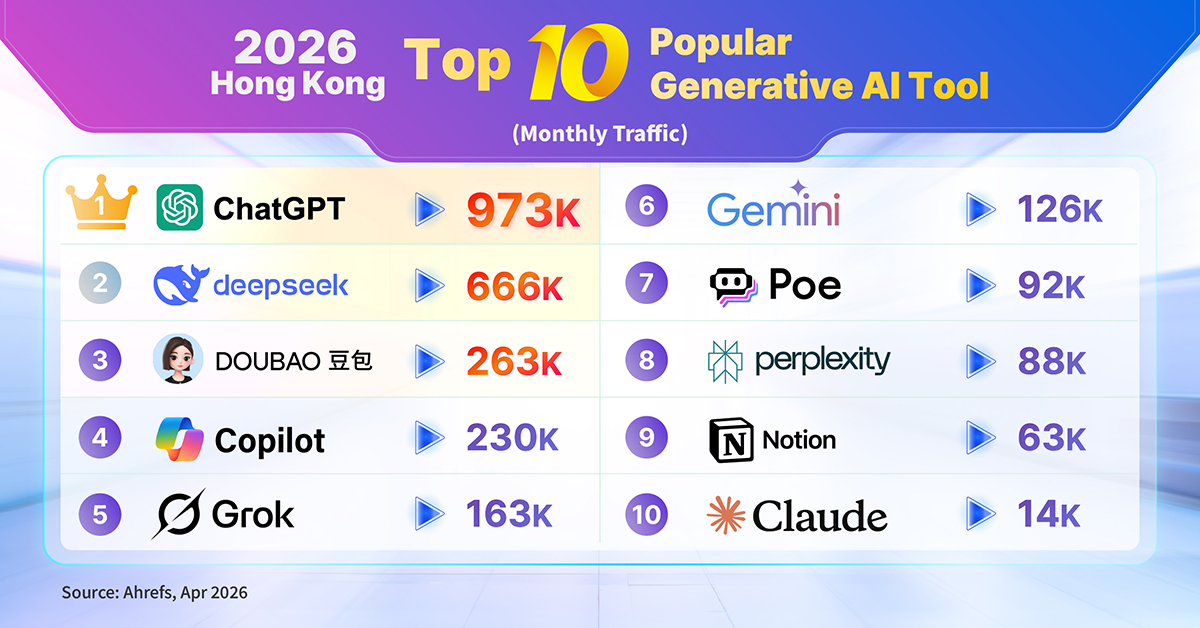
Generative AI has quietly moved from buzzword to background utility. But which AI tools are Hong Kongers actually using, and why? We dug into 2026's latest monthly traffic figures to build a data-driven AI ranking of the platforms shaping the AI Hong Kong landscape today and most names on this list offer free AI tools or generous free tiers, so there is little stopping you from trying them out.
1. ChatGPT (973K) — Still the Household Name
OpenAI's ChatGPT remains the runaway leader in the generative AI ranking. Much of its mainstream momentum can be traced back to the GPT-4o image generator launched in 2025, which set off the viral Studio Ghibli-style art trend and pulled a wave of casual Hong Kong users into the platform for the first time. That stickiness has carried into 2026, with GPT-5 now the default model, bringing sharper reasoning, better coding, and stronger multimodal handling. For most HK people, ChatGPT is simply the AI tool they open first.
2. DeepSeek (666K) — The Open-Source Challenger from the Mainland
DeepSeek's strong 2nd place finish says a lot about how open HK users are to Chinese generative AI. The newly released DeepSeek V4, built on a new Engram memory architecture, goes head-to-head with Claude and GPT on coding benchmarks and its mixture-of-experts (MoE) design keeps inference costs remarkably low. As one of the most capable free AI tools on the market today, DeepSeek is increasingly hard to ignore for users who want serious capability without high subscription costs.
3. Doubao (263K) — ByteDance's Multimodal All-Rounder
Doubao, ByteDance's homegrown assistant, has has secured a comfortable 3rd place. Beyond the usual chat, writing, and translation features, Doubao recently integrated the Seedance 2.0 video generation model and rolled out a technical preview of its "Doubao Mobile Assistant" — capable of autonomously hopping between apps to compare prices, book tickets, and place orders. It is one of the more concrete examples of AI agents actually doing things, rather than just talking about doing them.
4. Microsoft Copilot (230K) — The Business Productivity Default
Copilot continues to benefit from Microsoft 365's massive install base. Recent updates extend its reach to multi-step edits on locally stored Excel across Windows and Mac, and Copilot Studio's custom agent capabilities keep expanding. If your day already runs on Outlook, Word, and Teams, Copilot is the path of least resistance.
5. Grok (163K) — Real-Time, Unfiltered, On X
Elon Musk's xAI keeps Grok positioned as the AI tool plugged directly into the pulse of X. The latest Grok 4.3 promises strong agentic tool calling with minimal hallucinations and offers both reasoning and non-reasoning modes. For anyone tracking real-time news, social trends, or doing quick sentiment checks, Grok offers something the others simply cannot match.
6. Google Gemini (126K) — The Quiet Workspace Power Play
Gemini's traffic looks modest on paper, but that is partly because much of its usage happens invisibly, embedded inside Gmail, Docs, and Sheets. Google has rolled out Gemini 3.1 Pro with another core intelligence bump, fully integrated into Google AI Studio. For anyone living in the Google ecosystem, Gemini is less a choice than a default.
7. POE (92K) — The Buffet of AI Models
Quora's POE has built a loyal following with a simple pitch: one subscription, dozens of models. Users can switch between Claude Opus 4.7, GPT-5.5 Pro, Nano-Banana-2 and thousands of community-built bots without juggling logins. Notably, POE has also become an indirect workaround for HK users who want to try Claude without setting up a VPN. It is a niche but meaningful advantage in this market.
8. Perplexity (88K) — The Researcher's Favourite
Perplexity has positioned itself as the AI search engine that actually cites its sources. The newly launched Comet browser bundles in Comet Assistant, capable of in-page research, summarisation, and autonomous multi-step tasks like making bookings or comparisons. If you write reports, do deep research, or just hate being fed unsourced answers, Perplexity earns its place on your bookmark bar.
9. Notion AI (63K) — From Notebook to Autonomous Teammate
Notion's latest 3.5 release introduces the Notion Developer Platform alongside Custom Agents that automate repetitive work, building and editing content based on triggers you define. For teams already running their wikis, project trackers, and meeting notes inside Notion, the addition of AI agents turns a tidy workspace into a genuinely active one.
10. Claude (14K) — The Cult Favourite HK Can't Officially Use
Claude's low traffic figure needs some context. Anthropic does not list Hong Kong among its supported regions, so local users need a VPN to access Claude directly, As of April 2026, Anthropic also introduced KYC checks (government ID and live selfie) for selected users, adding another layer of friction. Despite all that, Claude Opus 4.6 remains a favourite among writers, developers, and analysts who swear by its long-form reasoning, coding strengths, and notably grounded tone. Among the generative AI crowd, it is the expert user's pick.
HKT Powering AI Adoption with the Right Foundation
Whichever AI tools you pick, they are only as useful as the network that powers them and the security that protects what you put into them. HKT provides the enterprise-grade network infrastructure and cybersecurity solutions that keep generative AI running smoothly and safely for Hong Kong businesses. Get in touch with our team to map out an AI transformation path that fits your business.
Want to see how more AI technologies are reshaping Hong Kong enterprises?
HKT Enterprise Solutions Tech Week 2026 is taking place in July 2026, featuring the latest AI use cases, sessions from industry experts, and on-site consultation at our booths. Stay tuned!