AI & Robotics
2026 10 Healthcare Technologies IoMT Building Smart Hospital in Hong Kong
What is a Smart Hospital? The Vision for Hong Kong
A Smart Hospital is not just about upgrading physical infrastructure, it encompasses the digitalisation of medical services, clinical workflows, and facility management through 5G & AI, the IoT, and Big Data analytics to achieve better patient care. According to the Hospital Authority's strategic plan, smart hospitals represent the broader direction for sustainable development of Hong Kong's public healthcare system. The goal is to address pressures from an aging population. The Hong Kong Government's Smart City Blueprint also emphasises that using IoMT technology to enhance hospital operational efficiency, reduce the burden on frontline healthcare workers is the core vision for building a future healthcare system.
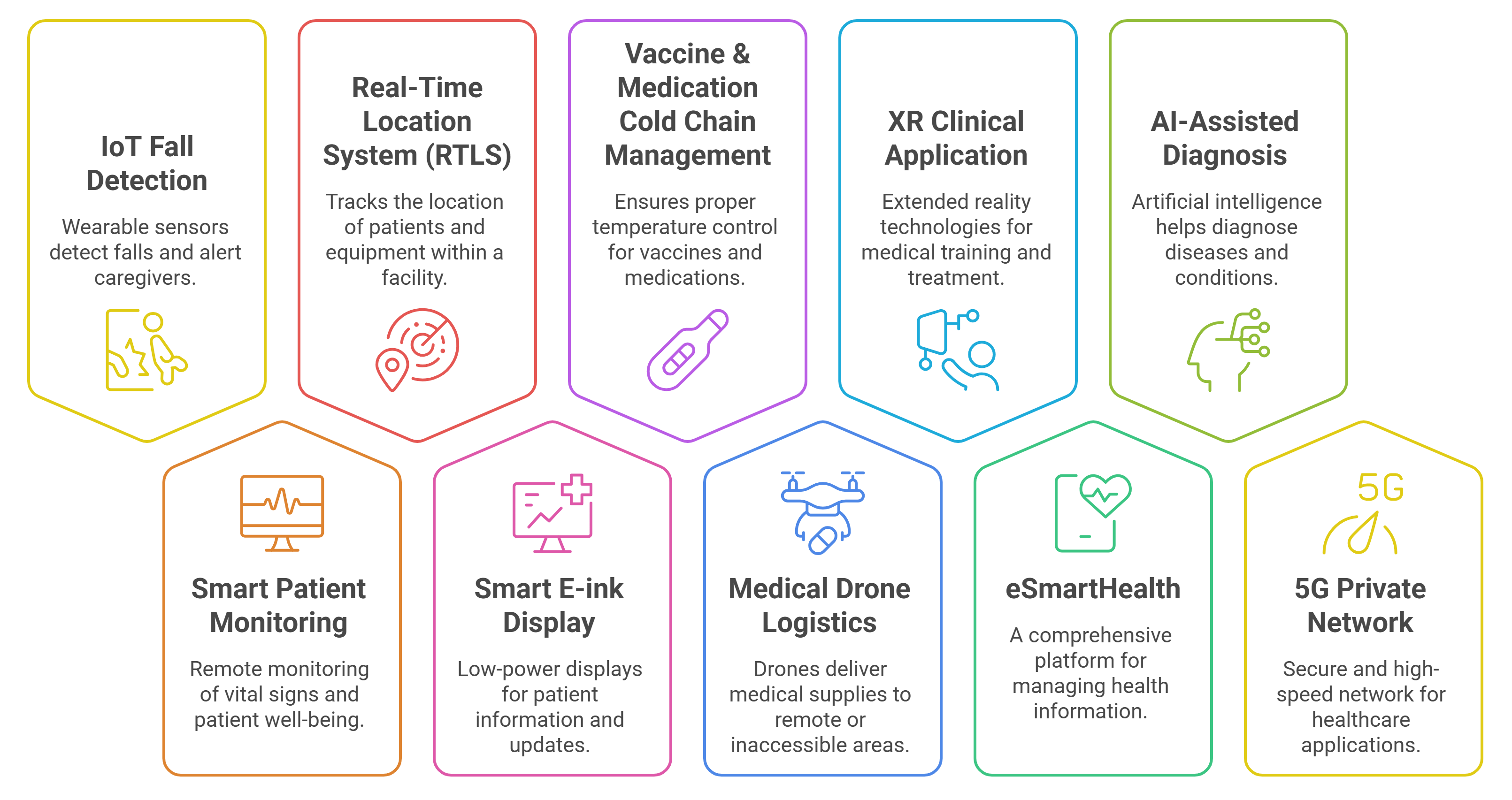
As a leading technology pioneer in Hong Kong, HKT integrates 5G, AI, and IoT technologies to support hospitals with the following 10 IoMT solutions for building smart hospitals.
1. IoT Fall Detection
Targeting common fall incidents in elderly wards and nursing homes, this system leverages IoT sensors and AI video analytics to instantly identify when patients fall. Once an incident is detected, the system automatically sends alerts to nurses, shortening the critical response time and providing safety monitoring.
2. Smart Patient Monitoring
Through medical-grade wearable devices, patients' vital signs (e.g. heart rate and SpO2) are tracked around the clock. Data is transmitted in real-time to the system, which triggers automatic alerts when readings show abnormal fluctuations. This allows healthcare staff to conduct proactive intervention, enhancing clinical safety.
3. Real-Time Location System (RTLS)
Using IoT tags, RTLS can precisely locate critical hospital assets (e.g. wheelchairs, infusion pumps, and emergency equipment) as well as patients' real-time positions within the complex hospital environment. This saves healthcare workers time searching for equipment and helps prevent patients with dementia from wandering off.
4. Smart E-ink Display
Replacing traditional handwritten paper, this E-ink is primarily applied to bedside patient cards and pharmacy labels. E-ink displays synchronise with online systems to instantly update patient care information, fasting reminders, and medication details, preventing medical errors caused by illegible handwriting or data entry mistakes.
5. Vaccine & Medication Cold Chain Management
For temperature-sensitive vaccines and specialty medications, IoT temperature sensors provide 24/7 monitoring. The system records real-time temperature changes in storage refrigerators and immediately sends alerts if readings exceed safe parameters, ensuring medication storage meets strict compliance standards.
6. Medical Drone Logistics
For medical supply transfers between different hospital buildings, drones create point-to-point aerial pathways. Whether it's urgent blood samples, pathology specimens, or medications, drones can bypass indoor congestion to rapidly complete delivery missions.
7. XR Clinical Application
Using AR and VR technologies to enhance physician training and surgical precision. Doctors can use VR to simulate complex surgical procedures pre-operatively or use AR during surgery to overlay collected 3D anatomical information onto the real surgical field, improving the accuracy of pre-surgical assessments and teaching efficiency for high-difficulty procedures (e.g. neurosurgery).
8. eSmartHealth Health Vital Sign Monitoring
No longer confined to hospital premises, this extends healthcare services into the community. Through eSmartHealth outreach services, patients can use self-service vital signs monitoring equipment at home to measure blood pressure, blood glucose, and other health data, uploading it to an integrated community care health monitoring system for remote tracking of discharged patients or those with chronic conditions.
9. AI-Assisted Diagnosis
By integrating vast pathology datasets and applying AI for deep analysis, this solution helps doctors more accurately interpret medical imaging (e.g. X-ray abnormality screening). AI also assists management in making more precise resource allocation decisions, optimising overall hospital operations.
10. 5G Private Network
A stable wireless network is a must for smart hospitals. HKT's 5G private network offers high speed, low latency, and enhanced privacy, ensuring critical healthcare technology applications remain interconnected while supporting real-time transmission of high-definition footage (e.g. 4K surgical feeds), providing robust network support for various smart IoMT applications.
HKT - Your Digital Transformation Partner for Smart Hospitals
The smart hospital IoMT solutions outlined above are not mere concepts; they are ready-to-go, proven applications. In recent years, HKT has assisted local public and private hospitals and healthcare institutions in deploying various smart hospital technology (IoMT) solutions, validated through real-world scenarios to ensure stability and reliability in actual healthcare environments.